Meshy 7 is Meshy AI's newest foundation model a rebuilt engine focused on one problem: making the 3D model actually match what you gave it, whether that's a text prompt or a reference photo.
Refined by the Meshy 7.1 update (Sep 10, 2026) · Ultra 4K geometry up to 4096³ · Live now on Free, Pro, Premium, Ultra & Studio
Meshy 7 isn't a bigger version of Meshy 6 it's trained differently, with alignment to your input as the explicit goal.
Reference images are read at multiple scales in one pass instead of a single flat pass, so fine shape cues that used to get averaged away are preserved going into generation.
Every training sample is paired precisely with its target geometry, with the effects of style, lighting and background systematically removed so the model learns shape, not surface appearance.
Geometry alignment is now measured directly as part of training evaluation, not checked afterward the model is optimized to match your input, not just to look plausible.
Official Meshy 7 launch: "Pushing the Frontier of 3D Alignment"
Meshy's own single-view geometry-alignment benchmark, published alongside the Meshy 7 release. Higher is better on all three metrics.
| Metric | Meshy 6 Lite | Tripo 3.1 | Meshy 7 |
|---|---|---|---|
| Overall Proportion | 78.2% | 79.0% | 81.0% |
| Spatial Distribution | 75.2% | 78.4% | 79.7% |
| Surface Details | 52.7% | 51.7% | 59.8% |
Meshy 7's largest jump over its predecessor is in fine surface detail a +7.1 point gain over Meshy 6 Lite. Source: Meshy 7 Geometry Alignment Benchmark, Meshy Blog, Aug 2026.
Meshy 7.1 is a focused update to Meshy 7's geometry engine. Once a model gets the overall shape and proportions right, the next frontier is surface detail engravings, stitching, scales, wrinkles built directly into the mesh instead of painted on as a texture. Meshy 7.1 substantially improves the generation stage responsible for exactly that, and introduces Ultra 2K and Ultra 4K modes that scale geometry resolution up from Meshy 7's standard 2048³.
Rolled out gradually to all users starting September 10, 2026.
Meshy measures Detail Richness as the fraction of a model's visible surface whose orientation varies significantly within a single rendered pixel using anti-aliasing analysis across multiple viewing angles at fixed screen resolutions. Higher means more genuine geometric detail is actually visible on screen.
| Render resolution | Meshy 7.1 | Hi3D 3.0 | Rodin 2.5 | Tripo 3.1 | Hunyuan3D 3.1 |
|---|---|---|---|---|---|
| 1024px | 53.5% | 49.1% | 51.4% | 44.8% | 39.4% |
| 2048px | 37.4% | 34.4% | 35.0% | 29.5% | 25.4% |
| 4096px | 23.1% | 21.9% | 21.1% | 17.3% | 14.7% |
Meshy 7.1 leads every competitor at every render resolution tested, winning 56% to 98% of head-to-head object comparisons at 4096px. Meshy also verified the gain is genuine structure, not noise: detail scores rose "without a significant drop in detail quality," and Ultra 4K output showed no visible noise or bumpiness on flat surfaces. Source: Meshy 7.1: Attention to the Closest Detail, Meshy Blog, Sep 2026.
Three geometry resolution tiers ship under Meshy 7.1. All registered users can generate at every tier; downloading Ultra 2K and Ultra 4K output requires a paid plan.
Real geometry beats a painted-on texture when:
Straight-off-the-generator results no post-processing.
Full workflow: prompt or image in, textured and export-ready mesh out.
Meshy 7 is the default for Text to 3D and Image to 3D, but older and specialised models stay selectable for the right job.
| Model | Best for | Generation time | Notes |
|---|---|---|---|
Meshy 7 (2026) |
Most detail, highest precision | < 1 minute | Default engine for Text to 3D & Image to 3D; refined further by Meshy 7.1 |
Meshy 6 (2025) |
High quality, stable structure | ~1 minute | Still selectable for existing workflows |
Smart Topology (2026) |
Game development & real-time rendering | ~10 seconds | Fastest option, tuned for production-ready polycounts |
What you can feed Meshy 7.
What comes back.
You can generate with Meshy 7 on the Free plan. Downloads are limited to earlier engine versions Meshy 7 models generate but need a paid plan to download.
Unlimited downloads of Meshy 7 and 7.1 models including Ultra 2K and Ultra 4K output, which any registered user can generate but only paid plans can download plus full commercial rights and private assets.
A Meshy 7 generation still costs 20 credits, mesh plus texture identical to every other engine. Failed tasks aren't charged.
Meshy 7 is Meshy AI's newest foundation model, released August 12, 2026. It's built around image-to-3D alignment an improved multi-scale image encoder and a rebuilt training pipeline that make the generated mesh match your text prompt or reference image more closely than previous engines.
Meshy 7 reads reference images at multiple scales instead of one flat pass, trains on data where style, lighting and background are stripped away from the geometry target, and measures alignment directly during training. On Meshy's own benchmark it leads Meshy 6 Lite on overall proportion, spatial distribution and especially surface detail.
Meshy 7.1, "Attention to the Closest Detail," released September 10, 2026, is a focused update to Meshy 7's geometry engine. Once a model gets overall shape and proportion right, the next problem is fine surface detail engravings, stitching, scales, wrinkles built into the mesh rather than painted on as a texture. Meshy 7.1 substantially improves that generation stage and introduces Ultra 2K and Ultra 4K modes.
Standard is Meshy 7's base 2048³ geometry resolution and supports both single-view and multi-view input on any plan. Ultra 2K is a sharper detail pass at the same base resolution, also single- and multi-view. Ultra 4K scales geometry resolution to 4096³ the highest of any 3D generative model to date but is single-view input only. Any registered user can generate Ultra 2K or Ultra 4K; downloading the result needs a paid plan.
Meshy built a new "Detail Richness" metric: the fraction of a model's visible surface whose orientation varies significantly within a single rendered pixel, measured via anti-aliasing analysis across multiple viewing angles. Meshy 7.1 leads Tripo 3.1, Hunyuan3D 3.1, Rodin 2.5 and Hi3D 3.0 at every tested render resolution (1024px, 2048px and 4096px), winning 56-98% of head-to-head object comparisons at 4096px.
Meshy says no detail scores rose "without a significant drop in detail quality," and Ultra 4K output showed no visible noise or bumpiness on flat surfaces in their testing. That said, compressed Web3D export formats can introduce their own artifacts, so it's worth judging quality on uncompressed geometry.
Likely yes, past 4096³. Meshy's own analysis suggests further scaling is unlikely to add detail most people can perceive, since a 4096×4096 render already approaches the limit of what human vision resolves on screen.
Both. Meshy 7 is the default engine for Text to 3D as well as Image to 3D. Its headline improvements are about image alignment, but it also generates directly from an 800-character text prompt in any language.
You can generate Meshy 7 and 7.1 models, including Ultra 2K and Ultra 4K, on the Free plan. Downloading them requires a paid plan (Pro, Premium, Ultra or Studio). Free-plan downloads are limited to earlier engine versions.
Anyone who needs maximum geometric fidelity from a single reference image 3D printing (where detail needs to survive as real geometry, not a texture), game assets viewed up close, sculpting workflows that start from a denser mesh, and hero production props. For most everyday props and characters, standard Meshy 7 generation is already a large step up from Meshy 6.
No. Every engine and tier Meshy 5, 6, 7, Standard, Ultra 2K, Ultra 4K and Smart Topology costs the same 20 credits per full generation (mesh + texture). There's no premium surcharge for using the newest model or the higher-resolution modes.
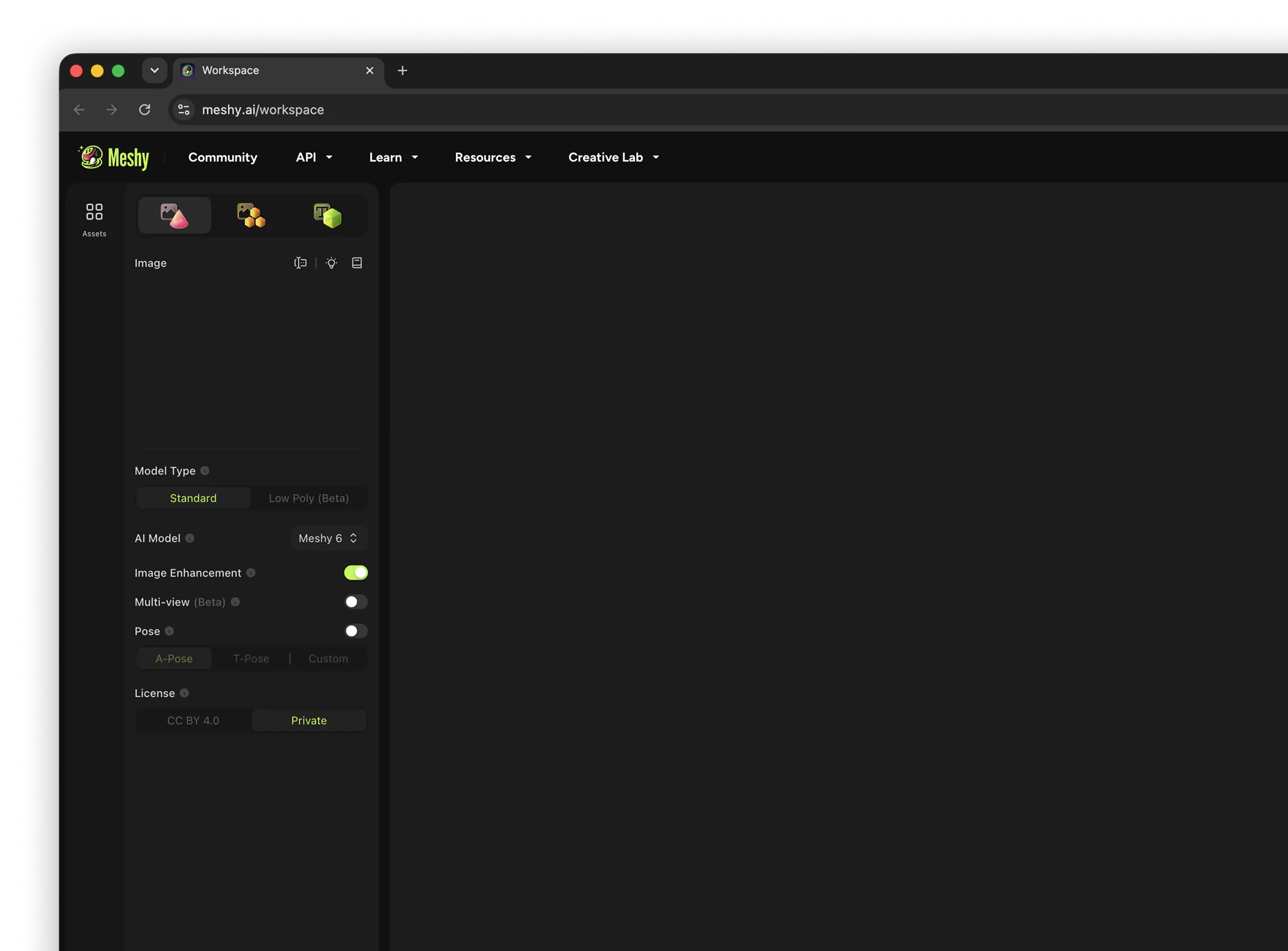
Generate with Meshy 7 today the Free plan includes 100 credits a month, enough to judge the alignment improvement for yourself.
Start Creating →